TWOFER · TWO-SIDED MARKETPLACE
CONCEPT + PROTOTYPE
Designing real-time demand for local businesses
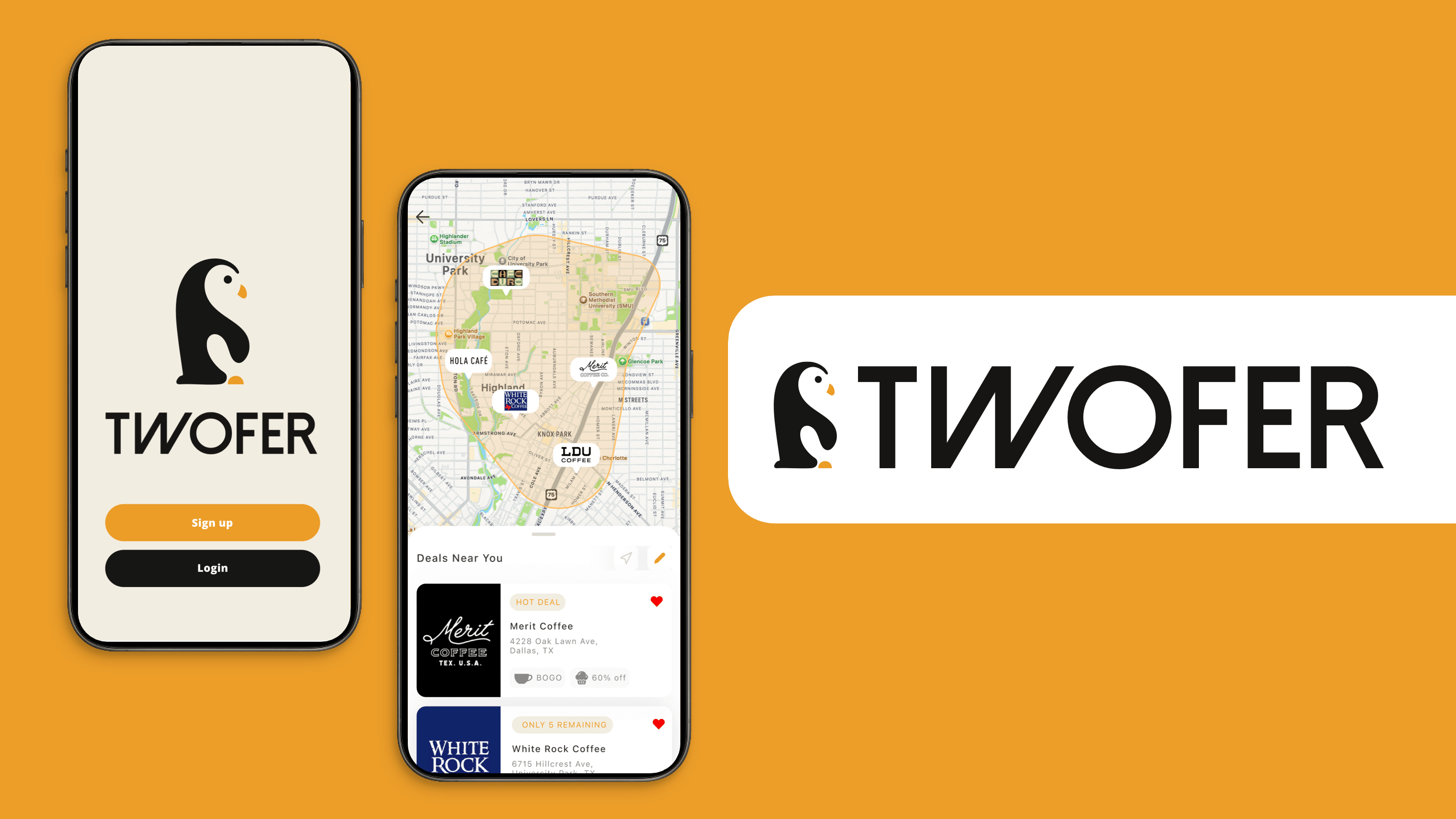
A two-sided marketplace that helps coffee shops and cafes fill slow hours with limited-time offers, while nearby consumers discover new local spots in real time. Powered by AI-driven offer creation and QR redemption.
Product strategy
Two-sided marketplace
Monetization
MVP scoping
Prototype
MY ROLE
Product strategy, UX design, prototype development
PRODUCT TYPE
Two-sided consumer + small business platform
STAGE
Concept + functional Figma prototype
KEY DECISIONS
Monetization model, MVP scope, real-time UX
THE PROBLEM
Local businesses lose money every slow hour, and existing tools don’t help much.
Cafes, small retailers, and restaurants live on thin margins and foot traffic. A slow Tuesday afternoon is lost revenue. Discount platforms, social promotions, and loyalty apps share one flaw: they’re static. A business posts a deal and waits, with no control over who sees it, when, or how many act on it.
These tools are built for businesses with marketing teams. A cafe owner with three employees and six empty tables at 3pm doesn’t have time to run a campaign.
THE OPPORTUNITY
Let businesses decide when demand happens.
Deals platforms train customers to wait for discounts. Twofer gives businesses control over the timing, quantity, and visibility of an offer, so they can shape demand without permanently cutting margins. The mechanism is controlled scarcity.
WHEN
The business picks the window the offer appears
HOW MANY
A fixed number of redemptions
HOW LONG
It disappears when time or quantity runs out
THE MARKET WE SAW
50%+
of Americans buy from a coffee shop at least once a week
53%
of Gen Z use loyalty apps one to two times a week
2×
as many Americans use app coupons as paper coupons
DISCOVERY
Owner interviews pointed to one window.
Before designing the admin side, we interviewed coffee shop owners. Weekday traffic ran at less than half of weekend levels, and the dip was predictable.
Dallas coffee shops we spoke with during discovery.
RELATIVE CUSTOMER TRAFFIC
Owners rated how busy each period feels on a 0 to 100 scale, where 100 is their busiest time of the week.
40
85
Weekday
11:30am to 1pm
Weekend
Saturday and Sunday
Traffic index from coffee shop owner interviews (0 to 100).
01
Slow periods are consistent and predictable
02
Current marketing only reaches existing customers
03
Owners are price sensitive and risk averse
04
A free trial is essential for supply-side adoption
05
The product must be simple and owner-controlled
OPPORTUNITY
11:30am to 1pm weekdays became the trial window.
KEY DECISIONS
Three decisions that shaped Twofer.
01
Businesses pay. Users don’t, yet.
AI-driven offer creation cost too much to give away. Businesses start free with one active offer, then move to Twofer Pro at $30 a month, which one recovered slow afternoon pays for.
START
Free
One active offer to prove the value first.
→
CONVERT TO TWOFER PRO
$30
/ month
One recovered slow afternoon pays for it.
THE TRADEOFF
We chose certainty over scale. Businesses only stay if it works, and we prioritized delivering real value to paying customers over the rapid growth of a free model.
02
No ratings or reviews in the MVP.
A credible ratings system needs volume, moderation and UI on both sides. With no users yet, it would sit mostly empty for months.
RATINGS ON DAY ONE
Corner Café
Coffee shop, 0.3 mi

No reviews yet
0 ratings
On launch day, every listing would look like this. An empty rating reads as a warning.
WHAT WE SHIPPED INSTEAD
BOGO latte
Corner Café, 0.3 mi
Ends in 42 min
14 of 20 claimed
Live quantities and a ticking clock show the offer is real and other people want it.
SAVED FOR V2
Ratings
Reviews
Search and filters
Consumer premium tier
THE TRADEOFF
A cleaner MVP over a more complete one. Real-time scarcity creates its own trust signal. Ratings wait for V2.
03
A live feed instead of search.
Search assumes you know what you want. A feed helps you discover, which fits offers that expire: open the app, see what’s live, decide.
SEARCH
What do you want?
Assumes you already know.
Offers expire before you find them.
LIVE NOW NEAR YOU

BOGO latte
ends 1:00 PM
3 left

2-for-1 pastries
ends 2:30 PM
5 left
Iced coffee BOGO
ends 12:15 PM
1 left
THE TRADEOFF
Speed of action over depth of choice. Businesses compete on what’s live right now.
THE USER EXPERIENCE
The user experience, built for the next 30 seconds.
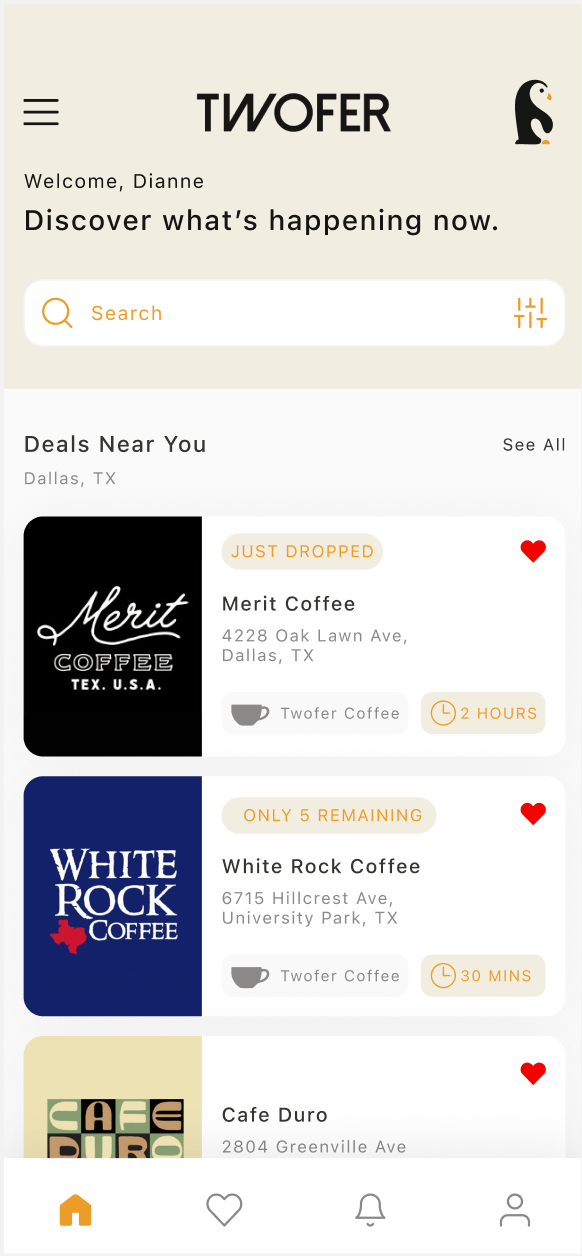
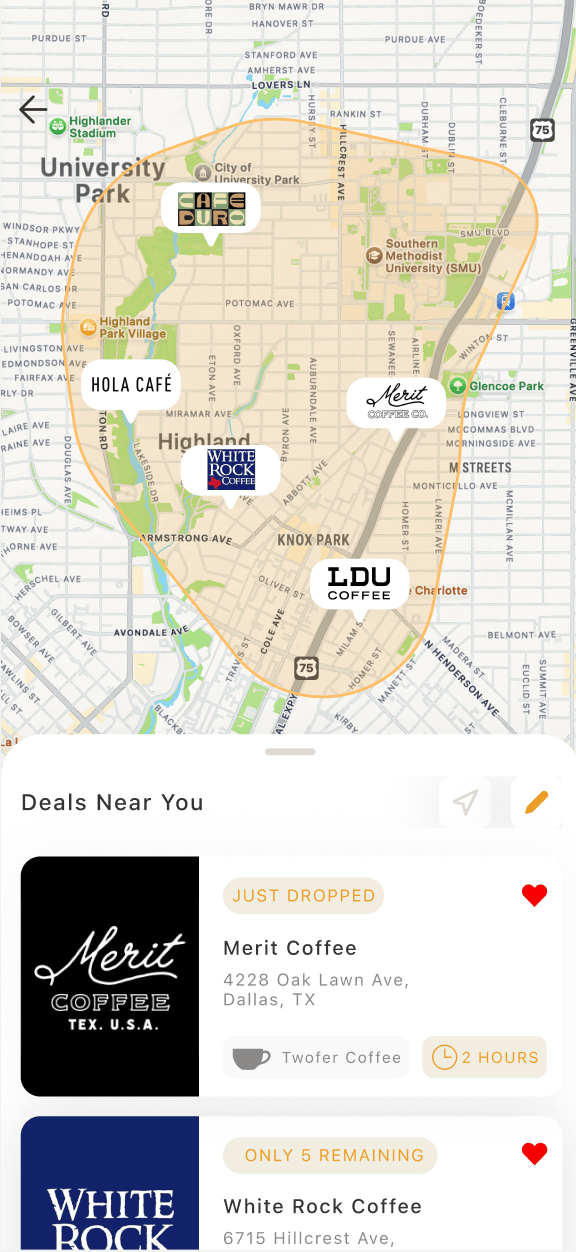
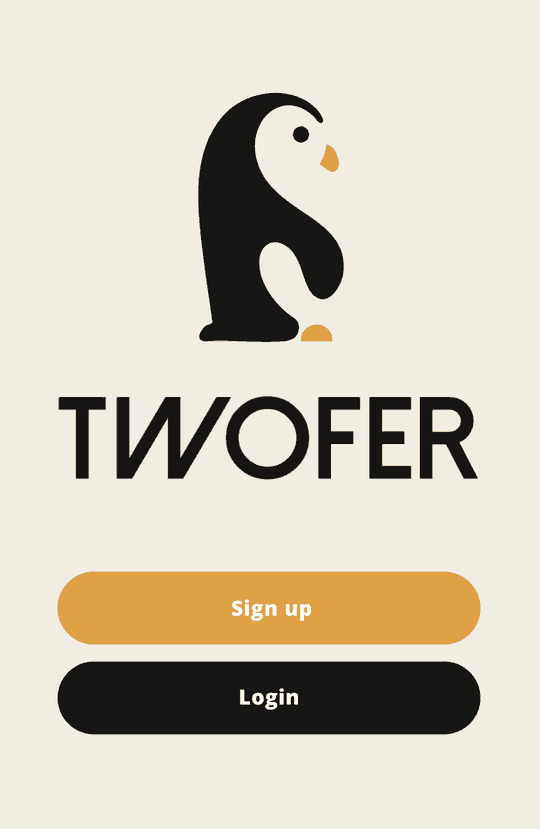
Every screen answers one question: what’s available right now, near me, that I might act on? Scarcity shows visually through limited availability, live updates, and “just dropped” tags. A user goes from a timely alert to the offer to a QR code at the counter in under 30 seconds. QR redemption keeps checkout fast and needs almost no staff training.
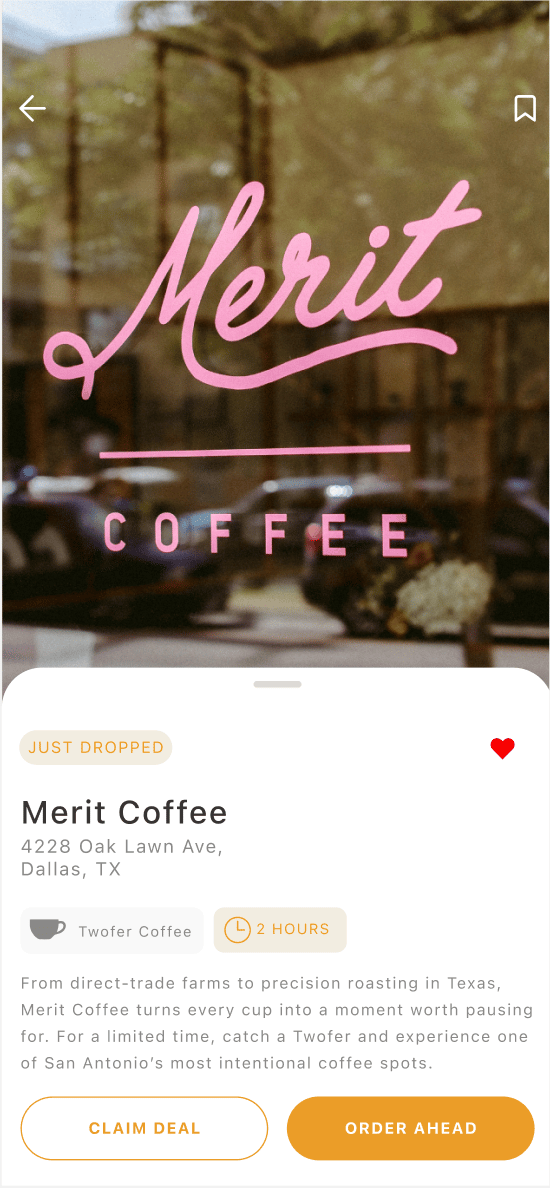

INTERACTIVE PROTOTYPE
Tap through Twofer yourself.
Go from a live offer to a QR code at the counter in under 30 seconds, the same flow we tested with users.
Try the prototype ↗
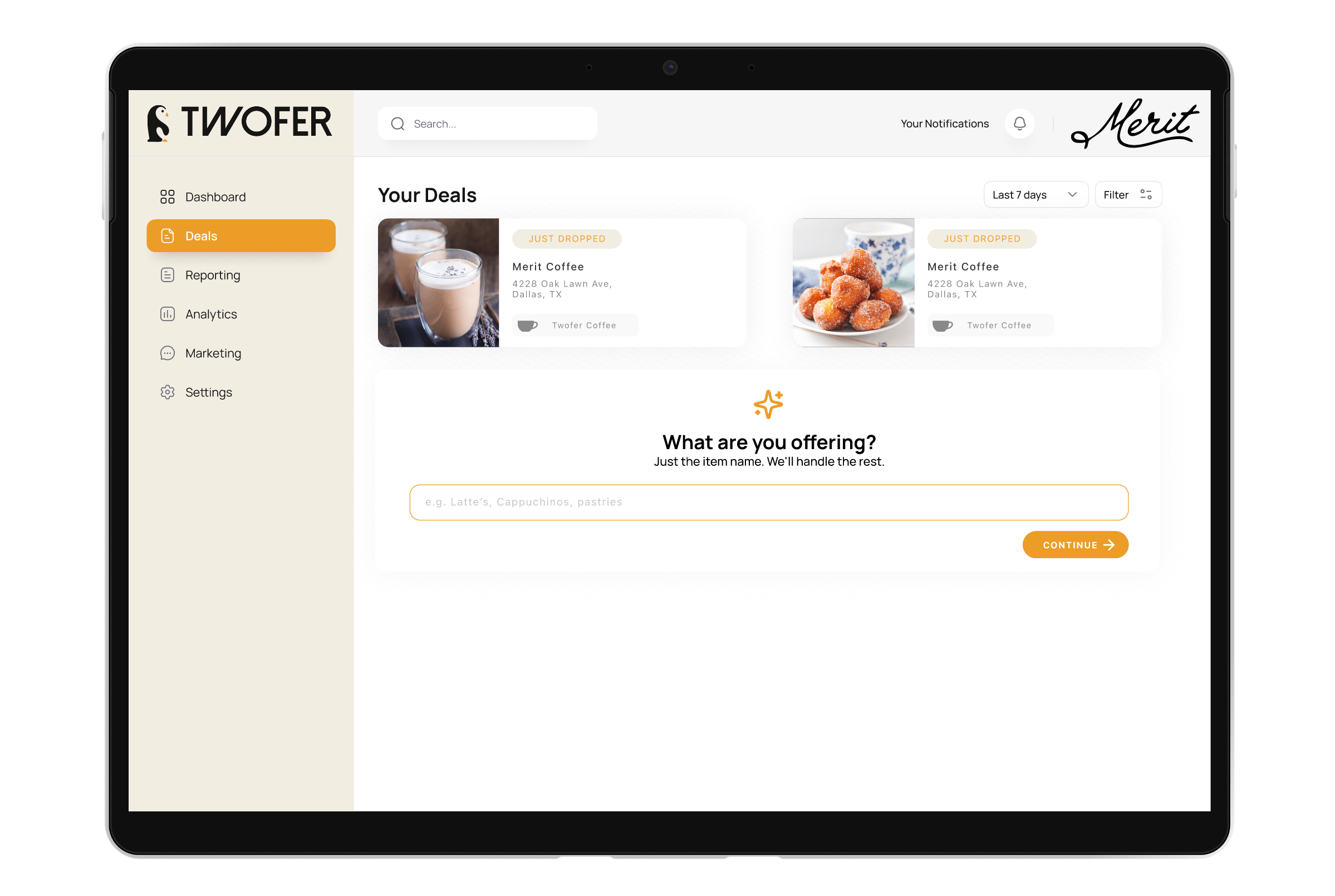
THE ADMIN EXPERIENCE
The admin tool: two minutes, then back to work.
Business owners are busy. The admin tool lets them create an offer, set it up, and get back to work in under two minutes. They control when an offer runs, how many are available, and how long it lasts. We cut campaign history, competitor benchmarking, and deep analytics from V1 and planned them for V2.
WHAT WE LEARNED
In testing, people acted faster on a short list of live offers.
In prototype testing, users engaged faster and with less hesitation in the live feed than in a browse-and-filter version. The time limit signaled the offer was worth a look. The harder lesson was the cold start: without businesses there’s nothing to discover, and without users businesses have no reason to post. We designed for business activation first.
LAUNCH PLAN
Solving the cold start: start small and dense.
A marketplace with no businesses has nothing to discover. We planned the launch supply-first, in one dense market: coffee shops in Dallas, near SMU and University Park.
DAY 0
Define one geo-targeted area
MONTH 1
Recruit 5 to 10 coffee shops, free for 3 months
MONTHS 1 TO 3
Drive local awareness: digital, launch events, flyers
ONGOING
Feature seamless redemption, then iterate on feedback
WHY DALLAS FIRST
1.33M
residents in a young, active market
About 2,000
coffee shops to recruit from
11:30 am – 1pm
the weekday slow window owners told us about
SUCCESS METRICS
How we’d know it’s working.
Each metric ties back to a decision on this page. We’d set targets after measuring a baseline in the first Dallas neighborhood.
NORTH STAR
Sell-through rate
The share of live offers that sell out before they expire.
If offers sell out, controlled scarcity is working for both sides: businesses fill the slow hour, and consumers are acting on what they see.
BUSINESS SIDE
Free-to-Pro conversion
Businesses that upgrade to Twofer Pro after the free tier
90-day retention
Businesses still posting offers after three months
CONSUMER SIDE
Alert to redemption
Time from notification to QR scan, with a goal of under 30 seconds
Repeat redemption
Users who redeem again within 30 days
GUARDRAIL
New-customer share
Redemptions from people new to that shop. Twofer has to reach beyond regulars, not just discount them
RETROSPECTIVE
What I’d do differently.
01
Watch business owners use the admin tool.
We built the offer flow on reasonable assumptions about what a cafe owner needs. Next time I’d watch a real owner use it before asking what they want.
02
Define the cold start strategy earlier.
We did pick Dallas and a supply-first plan, but only after the product was designed. The launch neighborhood and outreach for the first businesses should shape the product from day one.
THE PM TAKEAWAY
What I ask before adding a feature.
A two-sided marketplace makes you design for two very different users at once. Each Twofer tradeoff came down to one question: does this make it easier for someone to act, or add enough value to justify the complexity? I still ask it in product conversations.
LET’S TALK
Building for real people
at scale?
I’m looking for an Associate Product Manager role on a team like yours. LinkedIn is the fastest way to reach me.
NEXT CASE STUDY
Taste Test →
From 41 survey responses to a venture strategy.
TWOFER · TWO-SIDED MARKETPLACE
CONCEPT + PROTOTYPE
Designing real-time demand for local businesses
A two-sided marketplace that helps coffee shops and cafes fill slow hours with limited-time offers, while nearby consumers discover new local spots in real time. Powered by AI-driven offer creation and QR redemption.
Product strategy
Two-sided marketplace
Monetization
MVP scoping
Prototype
MY ROLE
Product strategy, UX design, prototype development
PRODUCT TYPE
Two-sided consumer + small business platform
STAGE
Concept + functional Figma prototype
KEY DECISIONS
Monetization model, MVP scope, real-time UX
THE PROBLEM
Local businesses lose money every slow hour, and existing tools don’t help much.
Cafes, small retailers, and restaurants live on thin margins and foot traffic. A slow Tuesday afternoon is lost revenue. Discount platforms, social promotions, and loyalty apps share one flaw: they’re static. A business posts a deal and waits, with no control over who sees it, when, or how many act on it.
These tools are built for businesses with marketing teams. A cafe owner with three employees and six empty tables at 3pm doesn’t have time to run a campaign.
THE OPPORTUNITY
Let businesses decide when demand happens.
Deals platforms train customers to wait for discounts. Twofer gives businesses control over the timing, quantity, and visibility of an offer, so they can shape demand without permanently cutting margins. The mechanism is controlled scarcity.
WHEN
The business picks the window the offer appears
HOW MANY
A fixed number of redemptions
HOW LONG
It disappears when time or quantity runs out
THE MARKET WE SAW
50%+
of Americans buy from a coffee shop at least once a week
53%
of Gen Z use loyalty apps one to two times a week
2×
as many Americans use app coupons as paper coupons
DISCOVERY
Owner interviews pointed to one window.
Before designing the admin side, we interviewed coffee shop owners. Weekday traffic ran at less than half of weekend levels, and the dip was predictable.
Dallas coffee shops we spoke with during discovery.
RELATIVE CUSTOMER TRAFFIC
Owners rated how busy each period feels on a 0 to 100 scale, where 100 is their busiest time of the week.
40
85
Weekday
11:30am to 1pm
Weekend
Saturday and Sunday
Traffic index from coffee shop owner interviews (0 to 100).
01
Slow periods are consistent and predictable
02
Current marketing only reaches existing customers
03
Owners are price sensitive and risk averse
04
A free trial is essential for supply-side adoption
05
The product must be simple and owner-controlled
OPPORTUNITY
11:30am to 1pm weekdays became the trial window.
KEY DECISIONS
Three decisions that shaped Twofer.
01
Businesses pay. Users don’t, yet.
AI-driven offer creation cost too much to give away. Businesses start free with one active offer, then move to Twofer Pro at $30 a month, which one recovered slow afternoon pays for.
START
Free
One active offer to prove the value first.
→
CONVERT TO TWOFER PRO
$30
/ month
One recovered slow afternoon pays for it.
THE TRADEOFF
We chose certainty over scale. Businesses only stay if it works, and we prioritized delivering real value to paying customers over the rapid growth of a free model.
02
No ratings or reviews in the MVP.
A credible ratings system needs volume, moderation and UI on both sides. With no users yet, it would sit mostly empty for months.
RATINGS ON DAY ONE
Corner Café
Coffee shop, 0.3 mi

No reviews yet
0 ratings
On launch day, every listing would look like this. An empty rating reads as a warning.
WHAT WE SHIPPED INSTEAD
BOGO latte
Corner Café, 0.3 mi
Ends in 42 min
14 of 20 claimed
Live quantities and a ticking clock show the offer is real and other people want it.
SAVED FOR V2
Ratings
Reviews
Search and filters
Consumer premium tier
THE TRADEOFF
A cleaner MVP over a more complete one. Real-time scarcity creates its own trust signal. Ratings wait for V2.
03
A live feed instead of search.
Search assumes you know what you want. A feed helps you discover, which fits offers that expire: open the app, see what’s live, decide.
SEARCH
What do you want?
Assumes you already know.
Offers expire before you find them.
LIVE NOW NEAR YOU

BOGO latte
ends 1:00 PM
3 left

2-for-1 pastries
ends 2:30 PM
5 left
Iced coffee BOGO
ends 12:15 PM
1 left
THE TRADEOFF
Speed of action over depth of choice. Businesses compete on what’s live right now.
THE USER EXPERIENCE
The user experience, built for the next 30 seconds.
Every screen answers one question: what’s available right now, near me, that I might act on? Scarcity shows visually through limited availability, live updates, and “just dropped” tags. A user goes from a timely alert to the offer to a QR code at the counter in under 30 seconds. QR redemption keeps checkout fast and needs almost no staff training.
INTERACTIVE PROTOTYPE
Tap through Twofer yourself.
Go from a live offer to a QR code at the counter in under 30 seconds, the same flow we tested with users.
Try the prototype ↗
THE ADMIN EXPERIENCE
The admin tool: two minutes, then back to work.
Business owners are busy. The admin tool lets them create an offer, set it up, and get back to work in under two minutes. They control when an offer runs, how many are available, and how long it lasts. We cut campaign history, competitor benchmarking, and deep analytics from V1 and planned them for V2.
WHAT WE LEARNED
In testing, people acted faster on a short list of live offers.
In prototype testing, users engaged faster and with less hesitation in the live feed than in a browse-and-filter version. The time limit signaled the offer was worth a look. The harder lesson was the cold start: without businesses there’s nothing to discover, and without users businesses have no reason to post. We designed for business activation first.
LAUNCH PLAN
Solving the cold start: start small and dense.
A marketplace with no businesses has nothing to discover. We planned the launch supply-first, in one dense market: coffee shops in Dallas, near SMU and University Park.
DAY 0
Define one geo-targeted area
MONTH 1
Recruit 5 to 10 coffee shops, free for 3 months
MONTHS 1 TO 3
Drive local awareness: digital, launch events, flyers
ONGOING
Feature seamless redemption, then iterate on feedback
WHY DALLAS FIRST
1.33M
residents in a young, active market
About 2,000
coffee shops to recruit from
11:30 am – 1pm
the weekday slow window owners told us about
SUCCESS METRICS
How we’d know it’s working.
Each metric ties back to a decision on this page. We’d set targets after measuring a baseline in the first Dallas neighborhood.
NORTH STAR
Sell-through rate
The share of live offers that sell out before they expire.
If offers sell out, controlled scarcity is working for both sides: businesses fill the slow hour, and consumers are acting on what they see.
BUSINESS SIDE
Free-to-Pro conversion
Businesses that upgrade to Twofer Pro after the free tier
90-day retention
Businesses still posting offers after three months
CONSUMER SIDE
Alert to redemption
Time from notification to QR scan, with a goal of under 30 seconds
Repeat redemption
Users who redeem again within 30 days
GUARDRAIL
New-customer share
Redemptions from people new to that shop. Twofer has to reach beyond regulars, not just discount them
RETROSPECTIVE
What I’d do differently.
01
Watch business owners use the admin tool.
We built the offer flow on reasonable assumptions about what a cafe owner needs. Next time I’d watch a real owner use it before asking what they want.
02
Define the cold start strategy earlier.
We did pick Dallas and a supply-first plan, but only after the product was designed. The launch neighborhood and outreach for the first businesses should shape the product from day one.
THE PM TAKEAWAY
What I ask before adding a feature.
A two-sided marketplace makes you design for two very different users at once. Each Twofer tradeoff came down to one question: does this make it easier for someone to act, or add enough value to justify the complexity? I still ask it in product conversations.
LET’S TALK
Building for real people
at scale?
I’m looking for an Associate Product Manager role on a team like yours. LinkedIn is the fastest way to reach me.
NEXT CASE STUDY
Taste Test →
From 41 survey responses to a venture strategy.
TWOFER · TWO-SIDED MARKETPLACE · CONCEPT + PROTOTYPE
Designing real-time demand
for local businesses
A two-sided marketplace that helps coffee shops and cafes fill slow hours with limited-time offers, while nearby consumers discover new local spots in real time. Powered by AI-driven offer creation and QR redemption.
Product strategy
Two-sided marketplace
Monetization
MVP scoping
Prototype
MY ROLE
Product strategy, UX design, prototype development
PRODUCT TYPE
Two-sided consumer + small business platform
STAGE
Concept + functional Figma prototype
KEY DECISIONS
Monetization model, MVP scope, real-time UX
THE PROBLEM
Local businesses lose money every slow hour, and existing tools don’t help much.
Cafes, small retailers, and restaurants live on thin margins and foot traffic. A slow Tuesday afternoon is lost revenue. Discount platforms, social promotions, and loyalty apps share one flaw: they’re static. A business posts a deal and waits, with no control over who sees it, when, or how many act on it.
These tools are built for businesses with marketing teams. A cafe owner with three employees and six empty tables at 3pm doesn’t have time to run a campaign.
THE OPPORTUNITY
Let businesses decide when demand happens.
Deals platforms train customers to wait for discounts. Twofer gives businesses control over the timing, quantity, and visibility of an offer, so they can shape demand without permanently cutting margins. The mechanism is controlled scarcity.
WHEN
The business picks the window the offer appears
HOW MANY
A fixed number of redemptions
HOW LONG
It disappears when time or quantity runs out
THE MARKET WE SAW
50%+
of Americans buy from a coffee shop at least once a week
53%
of Gen Z use loyalty apps one to two times a week
2×
as many Americans use app coupons as paper coupons
DISCOVERY
Owner interviews pointed to one window.
Before designing the admin side, we interviewed coffee shop owners. Weekday traffic ran at less than half of weekend levels, and the dip was predictable.
Dallas coffee shops we spoke with during discovery.
RELATIVE CUSTOMER TRAFFIC
Owners rated how busy each period feels on a 0 to 100 scale, where 100 is their busiest time of the week.
40
85
Weekday
11:30am to 1pm
Weekend
Saturday and Sunday
Traffic index from coffee shop owner interviews (0 to 100).
01
Slow periods are consistent and predictable
02
Current marketing only reaches existing customers
03
Owners are price sensitive and risk averse
04
A free trial is essential for supply-side adoption
05
The product must be simple and owner-controlled
OPPORTUNITY
11:30am to 1pm weekdays became the trial window.
KEY DECISIONS
Three decisions that shaped Twofer.
01
Businesses pay. Users don’t, yet.
AI-driven offer creation cost too much to give away. Businesses start free with one active offer, then move to Twofer Pro at $30 a month, which one recovered slow afternoon pays for.
START
Free
One active offer to prove the value first.
→
CONVERT TO TWOFER PRO
$30
/ month
One recovered slow afternoon pays for it.
THE TRADEOFF
We chose certainty over scale. Businesses only stay if it works, and we prioritized delivering real value to paying customers over the rapid growth of a free model.
02
No ratings or reviews in the MVP.
A credible ratings system needs volume, moderation and UI on both sides. With no users yet, it would sit mostly empty for months.
RATINGS ON DAY ONE
Corner Café
Coffee shop, 0.3 mi

No reviews yet
0 ratings
On launch day, every listing would look like this. An empty rating reads as a warning.
WHAT WE SHIPPED INSTEAD
BOGO latte
Corner Café, 0.3 mi
Ends in 42 min
14 of 20 claimed
Live quantities and a ticking clock show the offer is real and other people want it.
SAVED FOR V2
Ratings
Reviews
Search and filters
Consumer premium tier
THE TRADEOFF
A cleaner MVP over a more complete one. Real-time scarcity creates its own trust signal. Ratings wait for V2.
03
A live feed instead of search.
Search assumes you know what you want. A feed helps you discover, which fits offers that expire: open the app, see what’s live, decide.
SEARCH
What do you want?
Assumes you already know.
Offers expire before you find them.
LIVE NOW NEAR YOU

BOGO latte
ends 1:00 PM
3 left

2-for-1 pastries
ends 2:30 PM
5 left
Iced coffee BOGO
ends 12:15 PM
1 left
THE TRADEOFF
Speed of action over depth of choice. Businesses compete on what’s live right now.
THE USER EXPERIENCE
The user experience, built for the next 30 seconds.
Every screen answers one question: what’s available right now, near me, that I might act on? Scarcity shows visually through limited availability, live updates, and “just dropped” tags. A user goes from a timely alert to the offer to a QR code at the counter in under 30 seconds. QR redemption keeps checkout fast and needs almost no staff training.
INTERACTIVE PROTOTYPE
Tap through Twofer yourself.
Go from a live offer to a QR code at the counter in under 30 seconds, the same flow we tested with users.
Try the prototype ↗
THE ADMIN EXPERIENCE
The admin tool: two minutes, then back to work.
Business owners are busy. The admin tool lets them create an offer, set it up, and get back to work in under two minutes. They control when an offer runs, how many are available, and how long it lasts. We cut campaign history, competitor benchmarking, and deep analytics from V1 and planned them for V2.
WHAT WE LEARNED
In testing, people acted faster on a short list of live offers.
In prototype testing, users engaged faster and with less hesitation in the live feed than in a browse-and-filter version. The time limit signaled the offer was worth a look. The harder lesson was the cold start: without businesses there’s nothing to discover, and without users businesses have no reason to post. We designed for business activation first.
LAUNCH PLAN
Solving the cold start: start small and dense.
A marketplace with no businesses has nothing to discover. We planned the launch supply-first, in one dense market: coffee shops in Dallas, near SMU and University Park.
DAY 0
Define one geo-targeted area
MONTH 1
Recruit 5 to 10 coffee shops, free for 3 months
MONTHS 1 TO 3
Drive local awareness: digital, launch events, flyers
ONGOING
Feature seamless redemption, then iterate on feedback
WHY DALLAS FIRST
1.33M
residents in a young, active market
About 2,000
coffee shops to recruit from
11:30 am–1pm
the weekday slow window owners told us about
SUCCESS METRICS
How we’d know it’s working.
Each metric ties back to a decision on this page. We’d set targets after measuring a baseline in the first Dallas neighborhood.
NORTH STAR
Sell-through rate
The share of live offers that sell out before they expire.
If offers sell out, controlled scarcity is working for both sides: businesses fill the slow hour, and consumers are acting on what they see.
BUSINESS SIDE
Free-to-Pro conversion
Businesses that upgrade to Twofer Pro after the free tier
90-day retention
Businesses still posting offers after three months
CONSUMER SIDE
Alert to redemption
Time from notification to QR scan, with a goal of under 30 seconds
Repeat redemption
Users who redeem again within 30 days
GUARDRAIL
New-customer share
Redemptions from people new to that shop. Twofer has to reach beyond regulars, not just discount them
RETROSPECTIVE
Where I can improve
01
Watch business owners use the admin tool.
We built the offer flow on reasonable assumptions about what a cafe owner needs. Next time I’d watch a real owner use it before asking what they want.
02
Define the cold start strategy earlier.
We did pick Dallas and a supply-first plan, but only after the product was designed. The launch neighborhood and outreach for the first businesses should shape the product from day one.
THE PM TAKEAWAY
What I ask before adding a feature.
A two-sided marketplace makes you design for two very different users at once. Each Twofer tradeoff came down to one question: does this make it easier for someone to act, or add enough value to justify the complexity? I still ask it in product conversations.
LET’S TALK
Building for real people at scale?
I’m looking for an Associate Product Manager role on a team like yours. The fastest way to reach me is LinkedIn.
NEXT CASE STUDY
Taste Test →
From 41 survey responses to a venture strategy.
TWOFER · TWO-SIDED MARKETPLACE · CONCEPT + PROTOTYPE
Designing real-time demand
for local businesses
A two-sided marketplace that helps coffee shops and cafes fill slow hours with limited-time offers, while nearby consumers discover new local spots in real time. Powered by AI-driven offer creation and QR redemption.
Product strategy
Two-sided marketplace
Monetization
MVP scoping
Prototype
MY ROLE
Product strategy, UX design, prototype development
PRODUCT TYPE
Two-sided consumer + small business platform
STAGE
Concept + functional Figma prototype
KEY DECISIONS
Monetization model, MVP scope, real-time UX
ON THIS PAGE
THE PROBLEM
Local businesses lose money every slow hour, and existing tools don’t help much.
Cafes, small retailers, and restaurants live on thin margins and foot traffic. A slow Tuesday afternoon is lost revenue. Discount platforms, social promotions, and loyalty apps share one flaw: they’re static. A business posts a deal and waits, with no control over who sees it, when, or how many act on it.
These tools are built for businesses with marketing teams. A cafe owner with three employees and six empty tables at 3pm doesn’t have time to run a campaign.
THE OPPORTUNITY
Let businesses decide when demand happens.
Deals platforms train customers to wait for discounts. Twofer gives businesses control over the timing, quantity, and visibility of an offer, so they can shape demand without permanently cutting margins. The mechanism is controlled scarcity.
WHEN
The business picks the window the offer appears
HOW MANY
A fixed number of redemptions
HOW LONG
It disappears when time or quantity runs out
THE MARKET WE SAW
50%+
of Americans buy from a coffee shop at least once a week
53%
of Gen Z use loyalty apps one to two times a week
2×
as many Americans use app coupons as paper coupons
DISCOVERY
Owner interviews pointed to one window.
Before designing the admin side, we interviewed coffee shop owners. Weekday traffic ran at less than half of weekend levels, and the dip was predictable.
Dallas coffee shops we spoke with during discovery.
RELATIVE CUSTOMER TRAFFIC
Owners rated how busy each period feels on a 0 to 100 scale, where 100 is their busiest time of the week.
40
85
Weekday
11:30am to 1pm
Weekend
Saturday and Sunday
Traffic index from coffee shop owner interviews (0 to 100).
01
Slow periods are consistent and predictable
02
Current marketing only reaches existing customers
03
Owners are price sensitive and risk averse
04
A free trial is essential for supply-side adoption
05
The product must be simple and owner-controlled
OPPORTUNITY
11:30am to 1pm weekdays became the trial window.
KEY DECISIONS
Three decisions that shaped Twofer.
01
Businesses pay. Users don’t, yet.
AI-driven offer creation cost too much to give away. Businesses start free with one active offer, then move to Twofer Pro at $30 a month, which one recovered slow afternoon pays for.
START
Free
One active offer to prove the value first.
→
CONVERT TO TWOFER PRO
$30
/ month
One recovered slow afternoon pays for it.
THE TRADEOFF
We chose certainty over scale. Businesses only stay if it works, and we prioritized delivering real value to paying customers over the rapid growth of a free model.
02
No ratings or reviews in the MVP.
A credible ratings system needs volume, moderation and UI on both sides. With no users yet, it would sit mostly empty for months.
RATINGS ON DAY ONE
Corner Café
Coffee shop, 0.3 mi
No reviews yet
0 ratings
On launch day, every listing would look like this. An empty rating reads as a warning.
WHAT WE SHIPPED INSTEAD
BOGO latte
Corner Café, 0.3 mi
Ends in 42 min
14 of 20 claimed
Live quantities and a ticking clock show the offer is real and other people want it.
SAVED FOR V2
Ratings
Reviews
Search and filters
Consumer premium tier
THE TRADEOFF
A cleaner MVP over a more complete one. Real-time scarcity creates its own trust signal. Ratings wait for V2.
03
A live feed instead of search.
Search assumes you know what you want. A feed helps you discover, which fits offers that expire: open the app, see what’s live, decide.
SEARCH
What do you want?
Assumes you already know.
Offers expire before you find them.
LIVE NOW NEAR YOU
BOGO latte
ends 1:00 PM
3 left
2-for-1 pastries
ends 2:30 PM
5 left
Iced coffee BOGO
ends 12:15 PM
1 left
THE TRADEOFF
Speed of action over depth of choice. Businesses compete on what’s live right now.
THE USER EXPERIENCE
The user experience, built for the next 30 seconds.
Every screen answers one question: what’s available right now, near me, that I might act on? Scarcity shows visually through limited availability, live updates, and “just dropped” tags. A user goes from a timely alert to the offer to a QR code at the counter in under 30 seconds. QR redemption keeps checkout fast and needs almost no staff training.
INTERACTIVE PROTOTYPE
Tap through Twofer yourself.
Go from a live offer to a QR code at the counter in under 30 seconds, the same flow we tested with users.
Try the prototype ↗
THE ADMIN EXPERIENCE
The admin tool: two minutes, then back to work.
Business owners are busy. The admin tool lets them create an offer, set it up, and get back to work in under two minutes. They control when an offer runs, how many are available, and how long it lasts. We cut campaign history, competitor benchmarking, and deep analytics from V1 and planned them for V2.
WHAT WE LEARNED
In testing, people acted faster on a short list of live offers.
In prototype testing, users engaged faster and with less hesitation in the live feed than in a browse-and-filter version. The time limit signaled the offer was worth a look. The harder lesson was the cold start: without businesses there’s nothing to discover, and without users businesses have no reason to post. We designed for business activation first.
LAUNCH PLAN
Solving the cold start: start small and dense.
A marketplace with no businesses has nothing to discover. We planned the launch supply-first, in one dense market: coffee shops in Dallas, near SMU and University Park.
DAY 0
Define one geo-targeted area
MONTH 1
Recruit 5 to 10 coffee shops, free for 3 months
MONTHS 1 TO 3
Drive local awareness: digital, launch events, flyers
ONGOING
Feature seamless redemption, then iterate on feedback
WHY DALLAS FIRST
1.33M
residents in a young, active market
About 2,000
coffee shops to recruit from
11:30 am–1pm
the weekday slow window owners told us about
SUCCESS METRICS
How we’d know it’s working.
Each metric ties back to a decision on this page. We’d set targets after measuring a baseline in the first Dallas neighborhood.
NORTH STAR
Sell-through rate
The share of live offers that sell out before they expire.
If offers sell out, controlled scarcity is working for both sides: businesses fill the slow hour, and consumers are acting on what they see.
BUSINESS SIDE
Free-to-Pro conversion
Businesses that upgrade to Twofer Pro after the free tier
90-day retention
Businesses still posting offers after three months
CONSUMER SIDE
Alert to redemption
Time from notification to QR scan, with a goal of under 30 seconds
Repeat redemption
Users who redeem again within 30 days
GUARDRAIL
New-customer share
Redemptions from people new to that shop. Twofer has to reach beyond regulars, not just discount them
RETROSPECTIVE
Where I can improve
01
Watch business owners use the admin tool.
We built the offer flow on reasonable assumptions about what a cafe owner needs. Next time I’d watch a real owner use it before asking what they want.
02
Define the cold start strategy earlier.
We did pick Dallas and a supply-first plan, but only after the product was designed. The launch neighborhood and outreach for the first businesses should shape the product from day one.
THE PM TAKEAWAY
What I ask before adding a feature.
A two-sided marketplace makes you design for two very different users at once. Each Twofer tradeoff came down to one question: does this make it easier for someone to act, or add enough value to justify the complexity? I still ask it in product conversations.
LET’S TALK
Building for real people at scale?
I’m looking for an Associate Product Manager role on a team like yours. The fastest way to reach me is LinkedIn.
NEXT CASE STUDY
Taste Test →
From 41 survey responses to a venture strategy.